
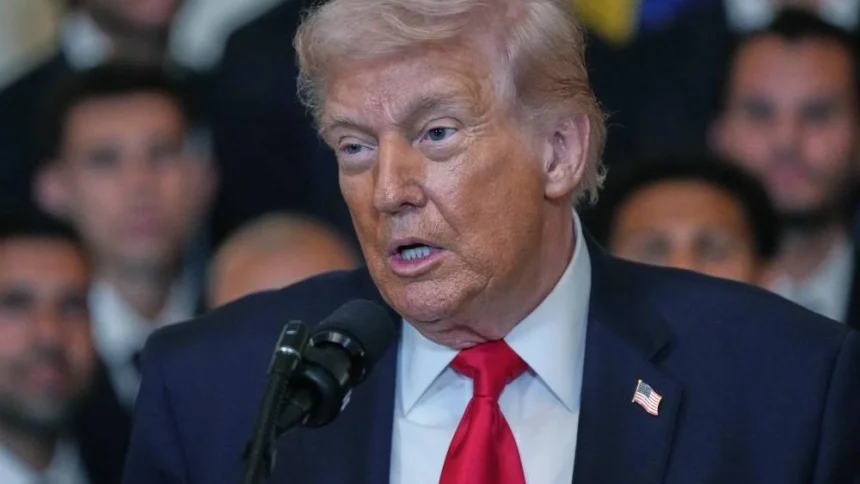
President Donald Trump said the United States will not negotiate an end to the war with Iran unless the country agrees to an “unconditional surrender,” a demand that rattled financial markets and pushed energy prices higher.
Trump made the statement Friday in a post on Truth Social, emphasizing that the conflict would not end through negotiations unless Iran first accepts defeat.
The comments came as fighting between U.S., Israeli, and Iranian forces continues to escalate across the Middle East.
Markets React to Trump’s Statement
Financial markets quickly responded after Trump posted his demand.
The Dow Jones Industrial Average dropped more than 900 points shortly after the announcement. The S&P 500 and Nasdaq Composite each fell about 1.6%.
At the same time, oil prices moved higher as traders reacted to the possibility that the conflict could drag on.
Investors remain concerned that the war could disrupt global energy supplies, especially shipments passing through key Middle Eastern shipping routes.
Trump Promises Economic Rebuilding After Surrender
Trump said that if Iran surrenders and installs what he described as an acceptable leadership structure, the United States and its allies would support rebuilding the country’s economy.
He wrote that Iran could become “economically bigger, better, and stronger than ever before” once the conflict ends.
Trump also used the phrase “Make Iran Great Again,” echoing his long-running political slogan.
The president’s statement came during a period of uncertainty in Iran’s leadership.
Iran Yet to Replace Supreme Leader
Iran has not yet announced a permanent successor to Ali Khamenei, who was killed in an airstrike carried out at the start of the war by the United States and Israel.
The leadership transition has created additional uncertainty about Iran’s next political and military decisions.
White House press secretary Karoline Leavitt declined to discuss which potential Iranian leaders U.S. intelligence agencies might be monitoring.
Rising Oil Prices Add Economic Pressure
Energy markets have become increasingly volatile as the conflict continues.
Saad al-Kaabi warned that the war could push crude oil prices significantly higher if oil tankers cannot safely travel through the Strait of Hormuz.
He said prices could reach as high as $150 per barrel if shipping routes remain blocked.
Such a surge could place additional pressure on the global economy, increasing fuel costs for businesses and consumers.
As the war continues, markets are watching closely for signs of escalation or diplomatic efforts that could stabilize the region and global energy supply.



0 Comments