
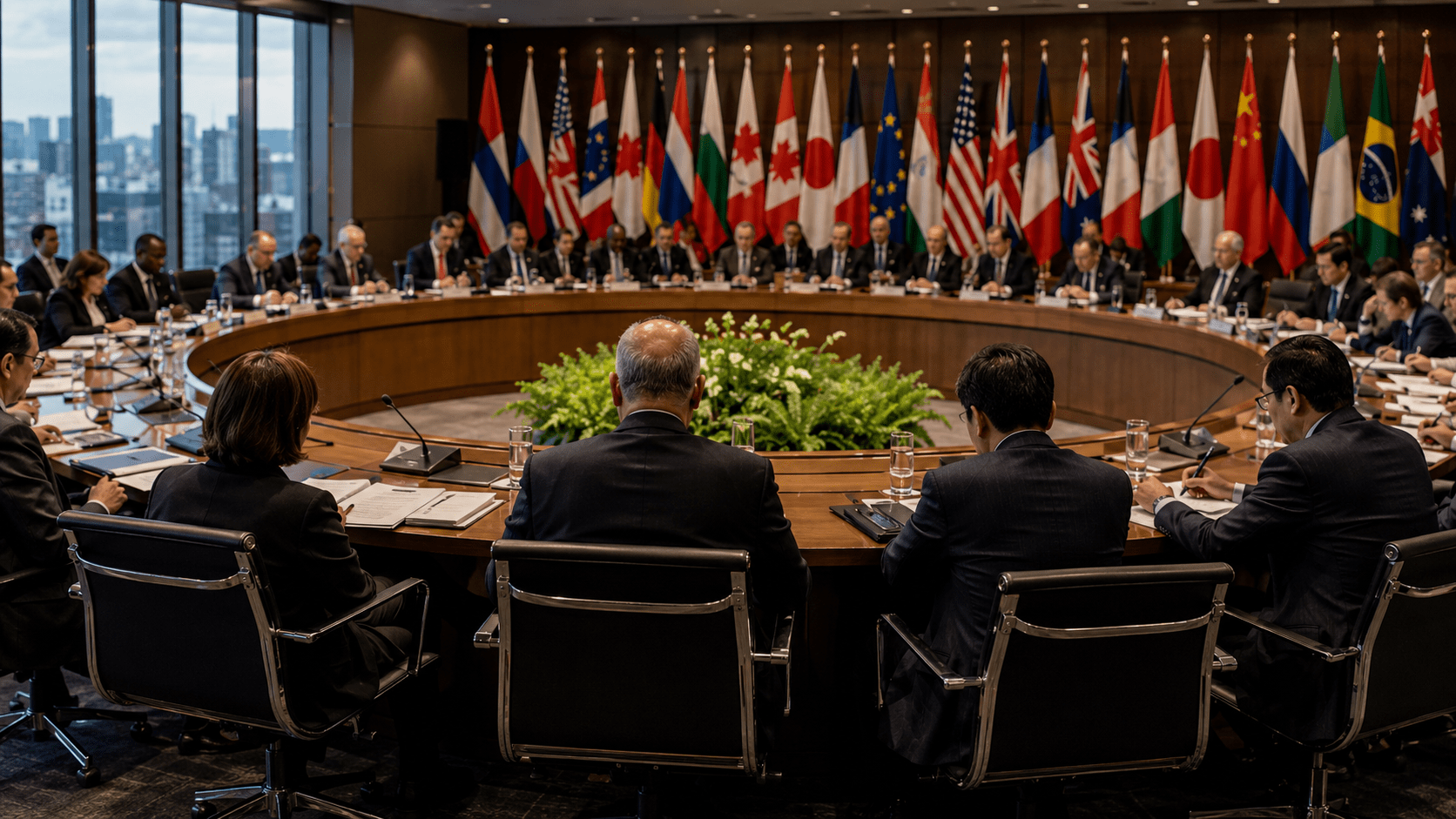
The Organisation for Economic Cooperation and Development has sharply cut its global growth forecast, warning that the economic damage from the U.S.-Iran war could deteriorate dramatically if disruptions to the Strait of Hormuz and Gulf energy infrastructure continue well into next year.
In its June Economic Outlook, the OECD said global growth is expected to slow from 3.4% in 2025 to 2.8% in 2026, before recovering to 3.1% in 2027, but only if a peace agreement is reached and current energy market disruptions begin easing by the middle of this year.
Two Scenarios With Vastly Different Consequences
The OECD laid out two distinct paths for the global economy depending on how quickly the conflict is resolved.
In the more benign scenario, a time-limited disruption in which hostilities end and the Strait of Hormuz reopens relatively soon, global growth slows but remains positive. Recovery begins in 2027 as energy prices retreat and supply chains normalize.
In the worst scenario, where disruptions to shipping and energy infrastructure continue well into 2027, global growth could collapse to just 2.1% in 2026 and fall further to 1.8% in 2027. OECD chief economist Stefano Scarpetta warned that outcome would tip some economies into recession or push them dangerously close to it.
Under the prolonged disruption scenario, global inflation would rise by an additional 0.4 percentage points in 2026 and 1.3 percentage points in 2027.
Unemployment would increase, business investment would weaken significantly, and financial markets could face a major repricing as elevated commodity prices collide with deteriorating demand.
The Human and Economic Toll Falls Unevenly
Scarpetta emphasized that the economic impact of the conflict is not being distributed equally across nations.
Asian economies face particular pressure from energy shortages, though countries like Japan and South Korea have substantial reserves and can weather a supply disruption for a meaningful period.
India, by contrast, is already rationing gas, illustrating how quickly the shortage becomes a daily hardship in economies with less buffer capacity.
The OECD’s report specifically highlighted the vulnerability of developing economies, noting that countries with limited energy reserves, higher shares of energy and food in household consumption, weak social safety nets, low private savings, and fragile currencies face the most severe consequences from a prolonged disruption.
“The consequences would be global but could prove especially severe for developing economies,” Scarpetta said.
AI Is the Only Bright Spot, With a Major Caveat
In an otherwise sobering outlook, the OECD identified AI investment as the one meaningful source of upside in its global projections.
Strong investment momentum from major technology companies is expected to support a significant increase in GDP per capita growth, averaging 0.4% across G20 countries and reaching 0.9% in the United States.
However, Scarpetta immediately qualified that projection.
“But, and it’s a big but, this depends very much on a resolution to the conflict in the Middle East and the easing of prices,” he said, pointing out that data centers require enormous amounts of energy to operate. If the energy shock persists, even the AI investment boom could be curtailed.
Supply Chain Vulnerability Laid Bare
The crisis has exposed how deeply the global economy depends on a single geographic chokepoint for its energy supply.
The OECD used its June report to call for stronger supply chain resilience and greater diversification of energy sources, arguing that the current crisis makes the case for reducing dependence on fossil fuel imports more urgent than at any previous point.
In the near term, the organization said emergency demand restraint measures and international coordination of strategic energy reserve releases can help cushion the supply shock. However, it framed these as stopgap measures rather than solutions.
“The longer the disruptions last, the larger the economic and social costs become,” Scarpetta said. “A durable settlement to the current conflict would not only bring relief to the region but also lay the groundwork for a resolution to the disruptions it has caused to the global economy.”
For central banks already struggling to balance slowing growth against rising inflation, the OECD’s dual-scenario framework underscores just how much the near-term economic trajectory depends on a diplomatic outcome that remains uncertain.



0 Comments