
Rising prices are closing in on American workers’ paychecks, and economists warn the gap could flip into negative territory within weeks as the economic fallout from the Iran conflict continues to ripple through the broader economy.
Government data shows that prices rose 3.3% on an annual basis in March, inching toward the 3.5% yearly growth rate recorded in average hourly earnings. On a monthly basis, the situation is already worse.
The 0.9% price increase between February and March alone was enough to push real average hourly pay into negative territory, with workers effectively earning $0.07 less per hour than the month prior as gasoline prices spiked.
Fed’s Preferred Inflation Gauge Hits Highest Level in Years
The Federal Reserve’s preferred measure of inflation, the Personal Consumption Expenditures price index, rose 0.7% in March from the prior month, pushing the annual rate to 3.5%. That marks the fastest pace of inflation since May 2023 and represents a sharp acceleration from February’s 2.8% annual reading.
The monthly increase came in above economists’ expectations and reflects the direct impact of the surge in gasoline prices triggered by the Iran conflict’s disruption of global oil supply.
Even stripping out food and energy, core PCE rose 3.2% on an annual basis, a figure that was in line with expectations but still signals that underlying price pressures were building even before the war began.
Wage Growth Is Being Overtaken
The convergence of rising prices and slowing wage growth is creating a painful squeeze for millions of American households.
Heather Long, chief economist at Navy Federal Credit Union, said inflation is “almost eating up the entirety of Americans’ wage gains already,” and warned it will almost certainly mean inflation is running ahead of wages by April or May.
That would mark a meaningful deterioration in financial conditions for working households that have not yet fully recovered from the inflation surge of the prior several years.
Michael Pearce, chief U.S. economist at Oxford Economics, said the “mounting hit to consumers’ real incomes from the energy price shock” will weigh on consumer spending in the first half of the year. He added that a further surge in oil prices or a stock market correction could push spending into outright decline.
The K-Shaped Split at the Gas Pump
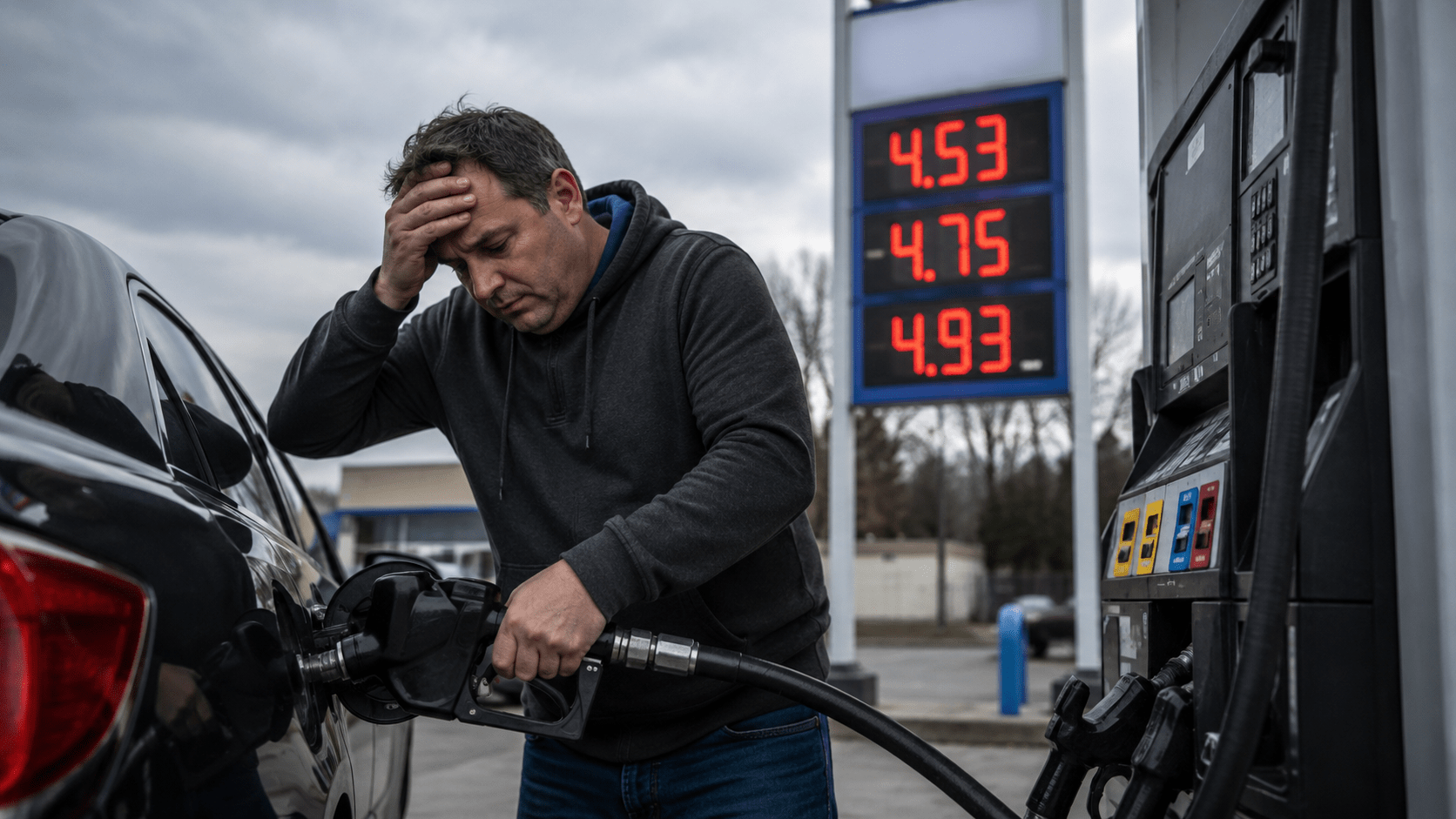
The pain is not being felt equally across income groups, and nowhere is that divide more visible than at the gas station.
With the national average price of gasoline sitting at $4.53 per gallon, economists at the New York Federal Reserve have documented a clear K-shaped pattern in how Americans are responding to higher fuel costs.
Lower-income households, which spend a disproportionately large share of their budgets on energy and transportation, have reduced their gasoline consumption by the largest margin in response to higher prices. Their nominal spending on gas has increased only modestly as a result.
Higher-income households, meanwhile, have done the least to cut back on consumption and have seen the largest absolute increase in gasoline spending.
The pattern mirrors what happened during the 2022 energy shock following Russia’s invasion of Ukraine, and economists say the same dynamics are playing out with greater intensity now.
Bank of America economists warned that lower-income households are already under financial stress, and further erosion of their real spending power from elevated energy prices could trigger another rise in credit card and auto loan delinquencies.
If that constrains access to credit, it could have a lasting effect on their ability to spend.
The Broader Wage Picture Remains Uneven
Data from the Bank of America Institute highlights the degree to which wage growth itself has been uneven across income levels.
High-income households saw after-tax wage growth of 5.6% in March compared to a year earlier. For low-income and middle-income households, gains were just 1% and 2% respectively, both well below the current rate of inflation.
That gap means the households facing the steepest energy costs are also the ones receiving the weakest income growth, a combination that economists say is creating genuine financial hardship.
Despite the strain on household finances, National Economic Council director Kevin Hassett said at the White House that the American consumer remains resilient, pointing to strong credit card spending as evidence.
However, that framing has drawn pushback from economists who note that increased credit spending during a period of falling real wages often signals financial stress rather than strength.


0 Comments