
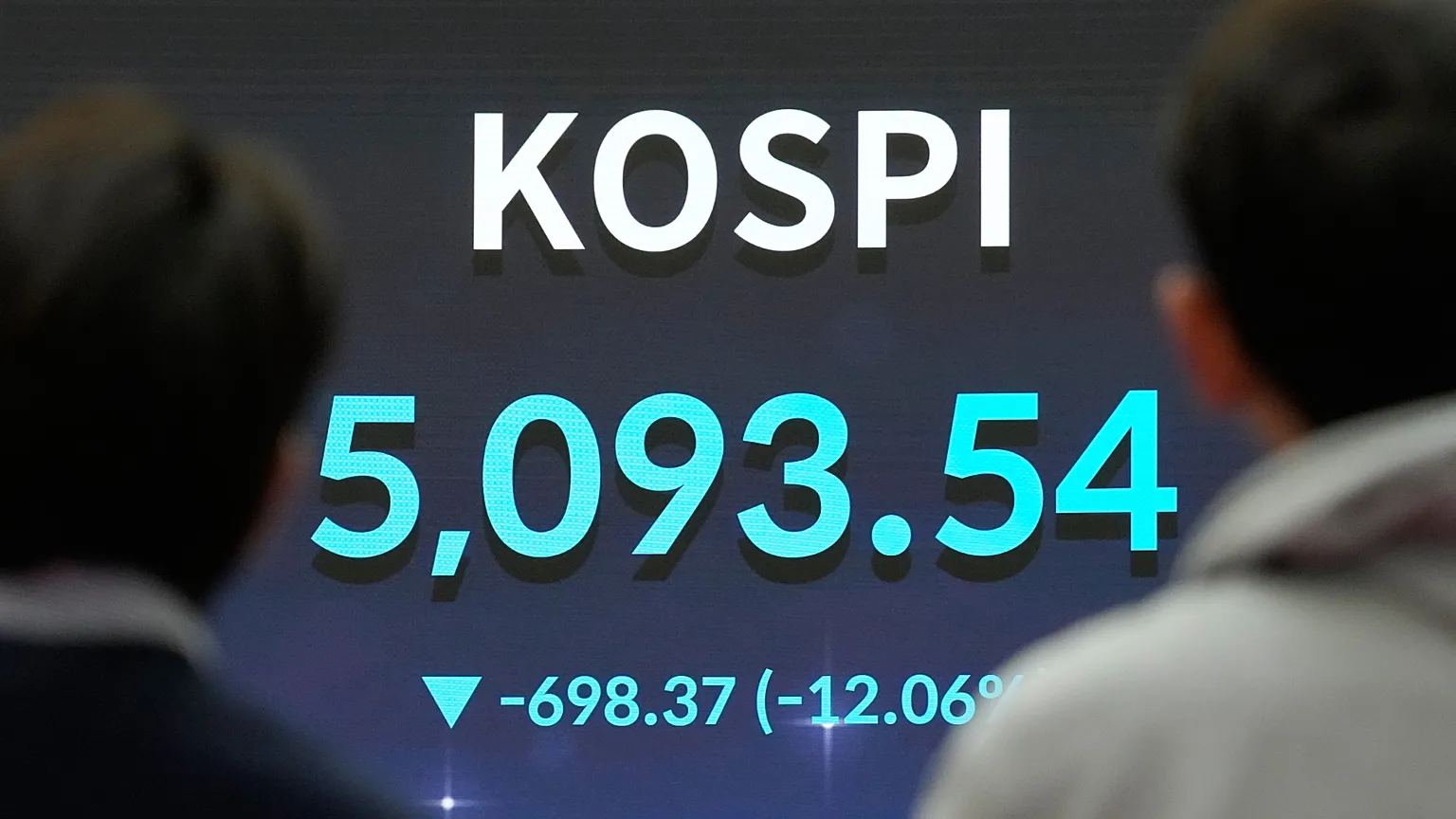
South Korea’s stock market has entered a period of extreme turbulence, with the benchmark Kospi index experiencing some of the most dramatic price swings in its history.
The sudden moves highlight how quickly sentiment can shift in markets that are heavily concentrated in a few sectors and exposed to global economic risks.
Just one year after being one of the world’s best-performing equity markets, South Korea is now experiencing intense volatility that has surprised many investors.
Record Drop Followed by Historic Rebound
The KOSPI Index plunged as much as 12% in a single trading session earlier this week. The drop marked the largest one-day decline ever recorded for the index.
Yet the dramatic fall was followed by a rapid rebound. The next trading session saw the Kospi climb nearly 10%, delivering its strongest daily gain since the global financial crisis in 2008.
Despite the rebound, the index continued to fluctuate sharply in subsequent trading sessions. Such large movements within a short period illustrate the unusually unstable environment facing investors.
Analysts say global geopolitical tensions have played a role in the sudden swings.
Global Uncertainty Adds Pressure
Investors have been reassessing risks across global markets following escalating conflict in the Middle East.
Higher oil prices and fears of supply disruptions have pushed investors toward safer assets while increasing volatility in equity markets.
For South Korea, these pressures are particularly significant because the country relies heavily on imported energy.
According to JPMorgan Asset Management strategist Raisah Rasid, markets with greater exposure to energy costs can experience stronger reactions to global oil price movements.
South Korea’s dependence on imported crude oil means that shocks in global energy markets can have a larger impact on investor sentiment.
Market Concentration Amplifies Moves
Another factor behind the sharp fluctuations is the structure of South Korea’s equity market.
A significant portion of Kospi’s value comes from a small number of technology companies, particularly semiconductor manufacturers.
Samsung Electronics and SK Hynix together account for a large share of the index’s market capitalization.
Because these companies dominate the index, strong gains or sudden declines in their stock prices can quickly move the entire market.
Both firms have seen major rallies over the past two years. SK Hynix surged dramatically in 2025 and has continued rising in 2026, while Samsung Electronics has also delivered strong gains.
Such concentrated leadership can help markets climb rapidly during bull runs. However, it also makes the index more vulnerable when investors begin taking profits.
Retail Trading Adds to Market Swings
South Korea’s large community of retail investors has also contributed to the volatility.
Many individual traders actively participate in the market using margin accounts or leveraged exchange-traded funds. These strategies can amplify gains during rallies but can also accelerate losses during market declines.
Daniel Yoo, global strategist at Yuanta Securities, noted that heavy leverage can trigger sudden waves of selling.
When stock prices fall quickly, margin calls can force investors to liquidate positions. That selling pressure can push prices down even further, creating a chain reaction across the market.
Recent data from the Korea Exchange shows that individual investors accounted for nearly half of total trading activity during one of the most volatile sessions.
Retail investors were also the largest net buyers during the rebound that followed the sharp sell-off.
Semiconductor Sector Still Strong
Despite the turbulence, many analysts believe the long-term outlook for South Korean equities remains positive.
The country’s semiconductor industry continues to benefit from strong demand for memory chips used in artificial intelligence systems and advanced computing.
Investment professionals say rising prices for memory products such as DRAM are expected to support earnings for major Korean chipmakers through 2026.
Kieron Poon, investment director at Aberdeen Investments, said the recent market pullback appears to be driven more by investor sentiment than by changes in underlying business conditions.
Volatility May Continue in the Short Term
Even with supportive fundamentals, market watchers warn that short-term volatility may persist.
Geopolitical tensions, energy price fluctuations, and high levels of leveraged trading could continue to produce sharp market movements.
Some analysts also caution that it may be too early to expect a rapid recovery following the recent swings.
Still, many investors believe the long-term drivers of South Korea’s stock market remain intact. Strong semiconductor demand and the country’s position as a global technology leader continue to attract interest from international investors.
For now, however, South Korea stock market volatility remains one of the defining features of Asia’s equity landscape.


0 Comments