
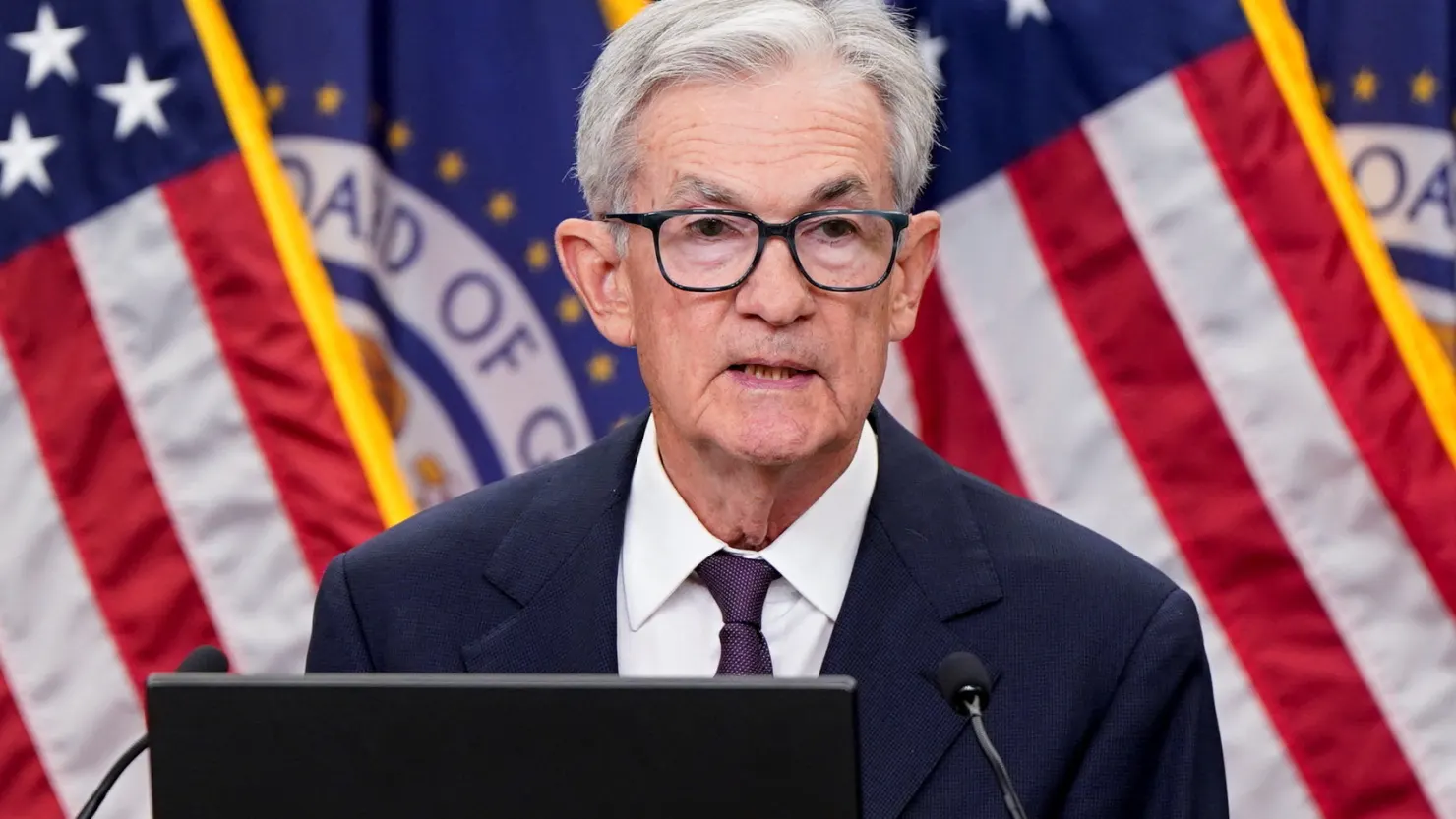
Federal Reserve Chair Jerome Powell has renewed warnings that stock prices may be stretched, raising fresh debate over whether a stock market correction or even a crash could occur in 2026.
While the S&P 500 remains near record highs and Wall Street forecasts continued gains, policymakers and analysts say elevated valuations could increase downside risk if economic expectations fail to materialize.
Powell flags elevated stock valuations as a potential risk
Federal Reserve officials do not directly target asset prices, but Powell previously noted that equities appear expensive by historical standards. Minutes from recent Federal Open Market Committee discussions echoed similar concerns, highlighting “stretched” valuations and the possibility of sharp market adjustments.
The Federal Reserve’s financial stability report also indicated that the S&P 500’s forward price-to-earnings ratio sits near the upper end of its historical range, a signal often associated with increased volatility.
At present, the benchmark index trades around 22.1 times forward earnings, well above its 10-year average near 18.8. Historically, such elevated multiples have coincided with periods of weaker long-term returns.
High valuations have appeared only twice in decades
Data from the Federal Reserve shows that the S&P 500 has sustained a forward P/E ratio above 22 only during two major periods in the last 40 years: the dot-com bubble and the COVID-19 pandemic rally.
In both cases, markets eventually entered bear territory.
Historical performance following similar valuations shows mixed results. Over the year after exceeding a 22 multiple, the S&P 500 posted average gains of roughly 7%, but over a two-year period, returns averaged a decline of about 6%. Analysts caution that high valuations do not guarantee a crash, but they can increase the market’s sensitivity to economic shocks or disappointing earnings.
Wall Street remains optimistic despite risks
Despite warnings from policymakers, many investment banks continue to project double-digit gains for the S&P 500 through the remainder of 2026. Analysts expect stronger corporate earnings growth, with forecasts calling for revenue increases above 7% and profit growth exceeding 15%.
Among 19 major firms surveyed, the median year-end target for the index sits near 7,600, implying roughly 10% upside from current levels.
However, historical accuracy of such forecasts has been mixed. Over the past four years, consensus projections have missed actual performance by wide margins, underscoring the uncertainty investors face.
What elevated valuations could mean for investors
A forward P/E ratio above historical norms does not automatically signal a market collapse. Instead, it suggests that future gains may depend heavily on strong economic growth and sustained earnings momentum.
If corporate results fail to meet expectations or if economic headwinds emerge, stocks could become more vulnerable to sharp drawdowns.
Investors often respond to such environments by diversifying portfolios, managing risk exposure, and focusing on long-term fundamentals rather than short-term forecasts.
A cautious outlook for the remainder of 2026
The combination of strong market optimism and rising valuation concerns has created a complex outlook for the year ahead. While economic growth and artificial intelligence-driven productivity gains could continue supporting equities, policymakers stress that markets remain sensitive to changes in inflation, interest rates, and global trade developments.
For now, Powell’s warning serves as a reminder that record highs do not eliminate risk. As the Federal Reserve continues to monitor financial stability, investors may need to balance bullish expectations with the possibility of increased volatility in the months ahead.



0 Comments